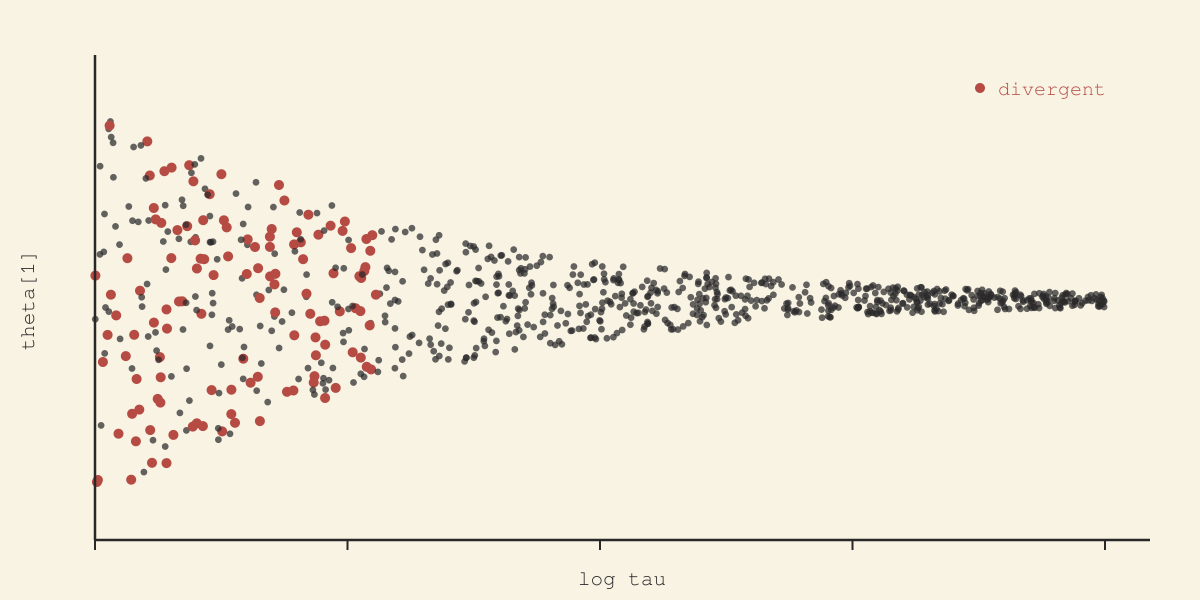
The posterior is a funnel. Below a certain scale the step size that works in the neck is catastrophically wrong in the mouth, and the sampler either grinds to a halt or sails straight past the region carrying the mass. Non-centred parameterisation is not a trick; it is a change of coordinates that makes the geometry tractable.
Where the sampler stalls
Neal's funnel is the canonical example. Write a hierarchical model in its natural form and the joint density develops a region so narrow that no single step size can explore it.
The denominator is the whole problem. For anything beyond a toy model it has no closed form, which is why we sample instead of integrate. Inline maths works too: the scale parameter controls how tight the neck becomes, and as the geometry degenerates.
Diagnosing it
Divergent transitions are the signal. Do not filter them out.
requires cmdstanpy and arviz
import arviz as az

idata = az.from_cmdstanpy(fit)
print(az.summary(idata, var_names=["mu", "tau"]))

# divergences are stored alongside the draws
n_div = int(idata.sample_stats["diverging"].sum())
print(f"{n_div} divergent transitions")
| Diagnostic | Healthy | Funnel (centred) |
|---|---|---|
| Divergences | 0 | 412 |
| Max tree depth hit | 0 | 91 |
| Bulk ESS | 3800 | 47 |
The fix
Sample a standardised variable and transform. The sampler explores a well-conditioned space, and the pathological geometry disappears.
parameters {
  vector[J] theta_raw;
  real<lower=0> tau;
}
transformed parameters {
  vector[J] theta = mu + tau * theta_raw;
}
model {
  theta_raw ~ std_normal();
  y ~ normal(theta, sigma);
}
Run it again and the divergences vanish. The lesson generalises: when a sampler struggles, suspect the parameterisation before you suspect the sampler.1
Footnotes
-
Betancourt, A Conceptual Introduction to Hamiltonian Monte Carlo, arXiv
.02434. ↩